
Tired of hot-and-cold rooms, bulky wall heads, or a “temporary” portable AC that never really feels permanent? If we want a cleaner look and more even comfort, a concealed ducted mini-split can be an appealing middle ground between full central air and a standard ductless system.
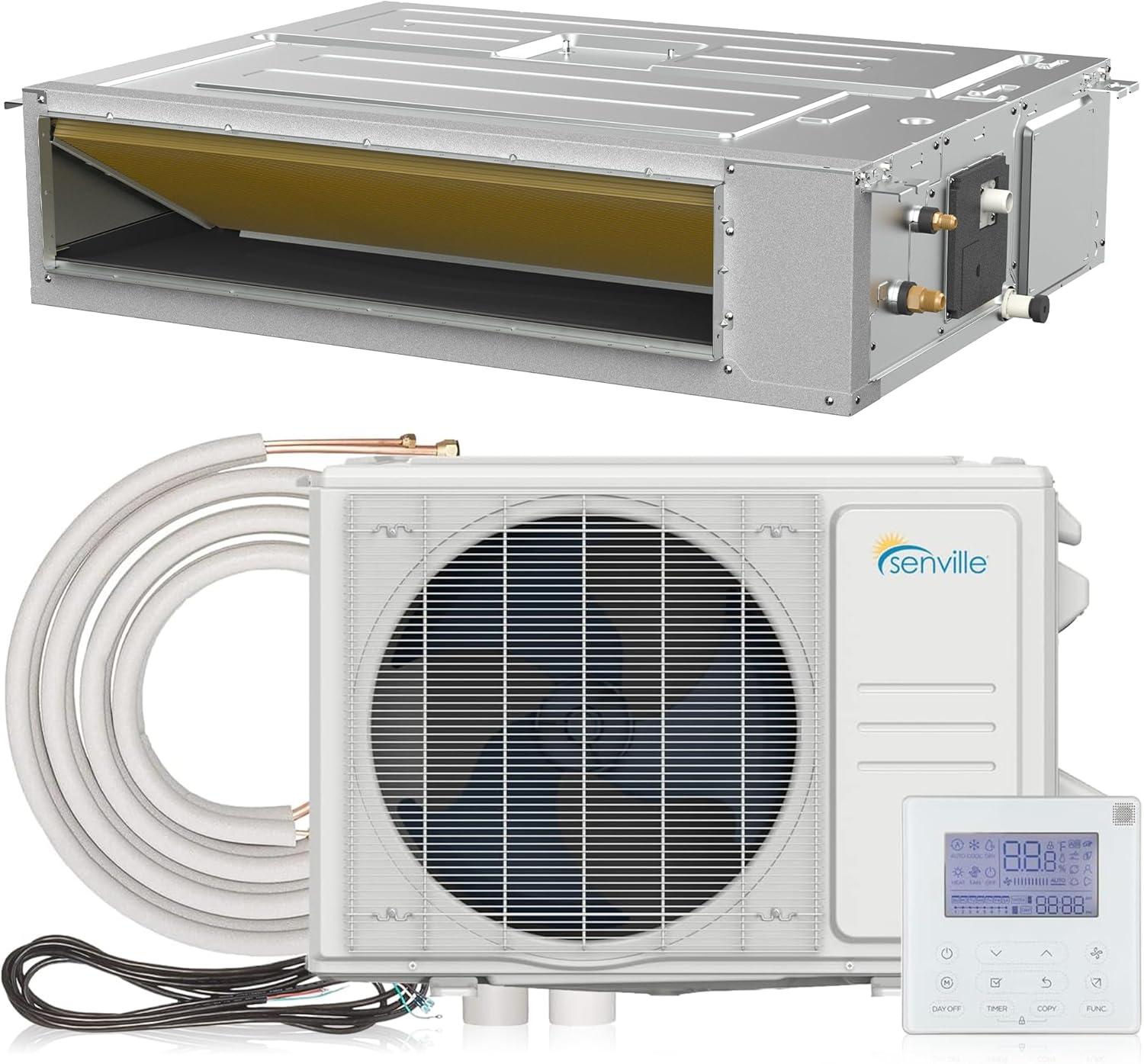
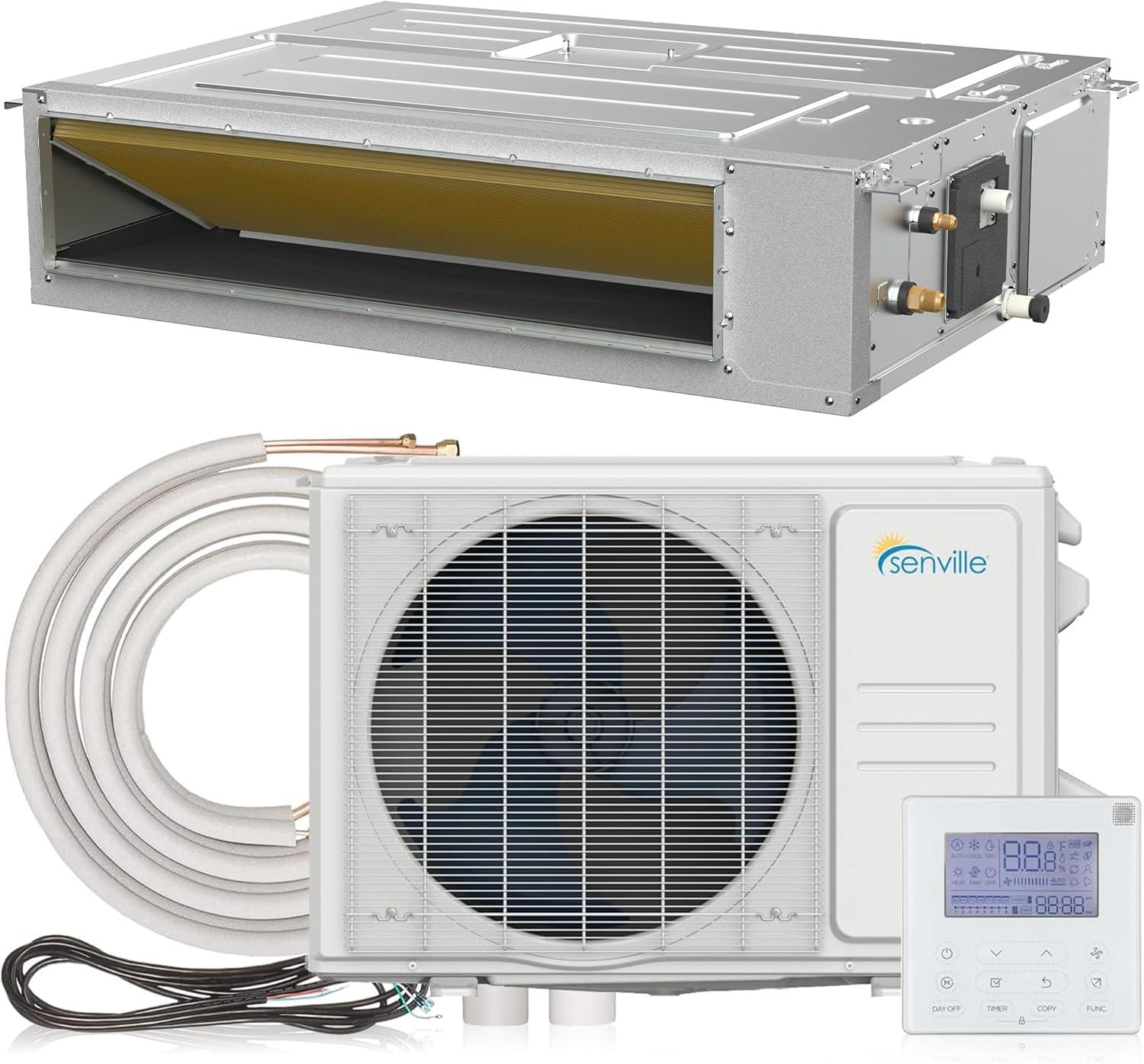
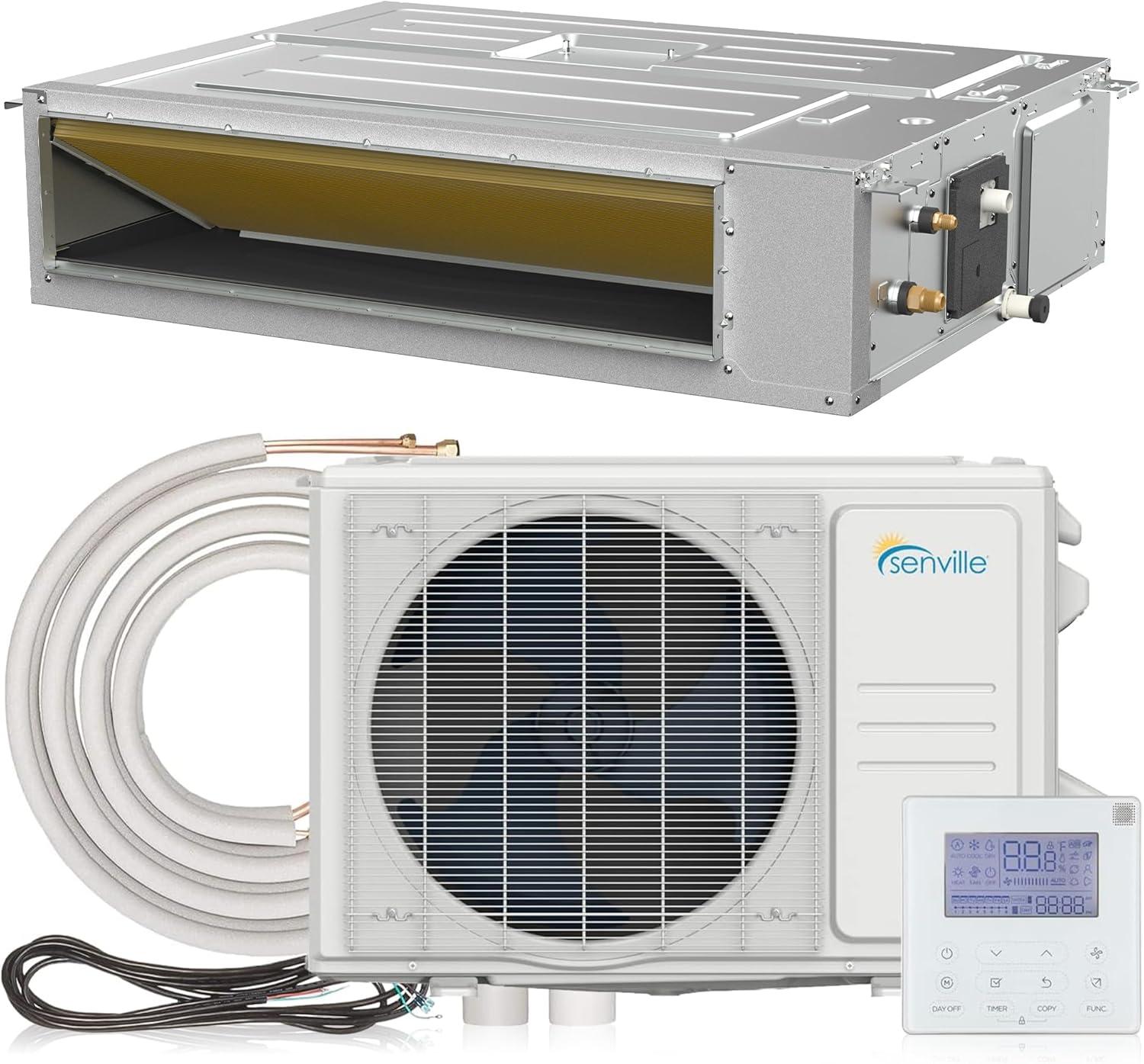
The Senville 12,000 BTU Ducted Mini Split AC/Heating System is a low-profile, concealed-duct heat pump package that includes a built-in drain pump, a wall thermostat, and a 16 ft. installation kit wiht pre-flared copper lines and dialogue cable. According to the manufacturer, it’s a 4-in-1 system (cooling, heating, dehumidifier, fan) and is rated for heating down to -22°F / -30°C, with “whisper quiet” operation and included technical support.
In this review, we’ll break down what the kit actually includes, what installation may involve (especially ductwork and thermostat wiring), what owners praise (quiet performance, solid heating/cooling), and what they critique (instructions, thermostat features, occasional reliability concerns).We’ve worked around enough mini-split installs and buyer feedback to know where these systems shine—and where surprises tend to show up.
Commercial Performance Overview for Our Small Business Spaces

For small business build-outs where you want a clean ceiling look (lobbies, salon suites, back offices, small retail), the Senville 12,000 BTU concealed-duct mini split is positioned as a flexible light-commercial option. According to Senville, it’s intended for “commercial applications” and offers a 4‑in‑1 system (cooling, heating, dehumidifier, fan/turbo) with a built-in drain pump—a practical feature when you can’t rely on gravity drainage above a drop ceiling. The manufacturer also states it’s rated for heating down to -22°F (-30°C) and ships with a 16 ft installation kit (pre-flared copper lines, communication cable) and the system is refrigerant pre-charged up to 25 ft, while still noting it requires professional installation.
In real-world feedback, commercial-style “set it and forget it” performance is a mixed but informative picture. multiple reviewers report the system is very quiet, and several mention dependable heating/cooling in whole-home or large-area setups (one user says the ducted version helped heat and cool a 1,000 sq. ft. home), while another HVAC-experienced reviewer said a 12k BTU unit cooled an upstairs area around 600 sq. ft. but noted the blower “never shuts off” even after reaching temperature. Cold-weather comments vary: one verified purchaser reports operation in ~5°F weather with no problems,while another says output starts to fall off around that temperature,and a different reviewer claims poor performance near 0°F. For small business spaces, the bigger commercial consideration may be controls and serviceability—some customers point out the thermostat isn’t Wi‑Fi/smart enabled and early documentation/wiring guidance can be thin, while others report responsive support; there’s also at least one report of a unit failing in the second year. the reviews suggest solid comfort potential when installed correctly, but it’s worth going in with realistic expectations around thermostat features, commissioning/setup, and how performance may vary at temperature extremes.Check Current Price & Customer Reviews on amazon →
Energy Cost Savings Real Numbers for Our Operating Budget
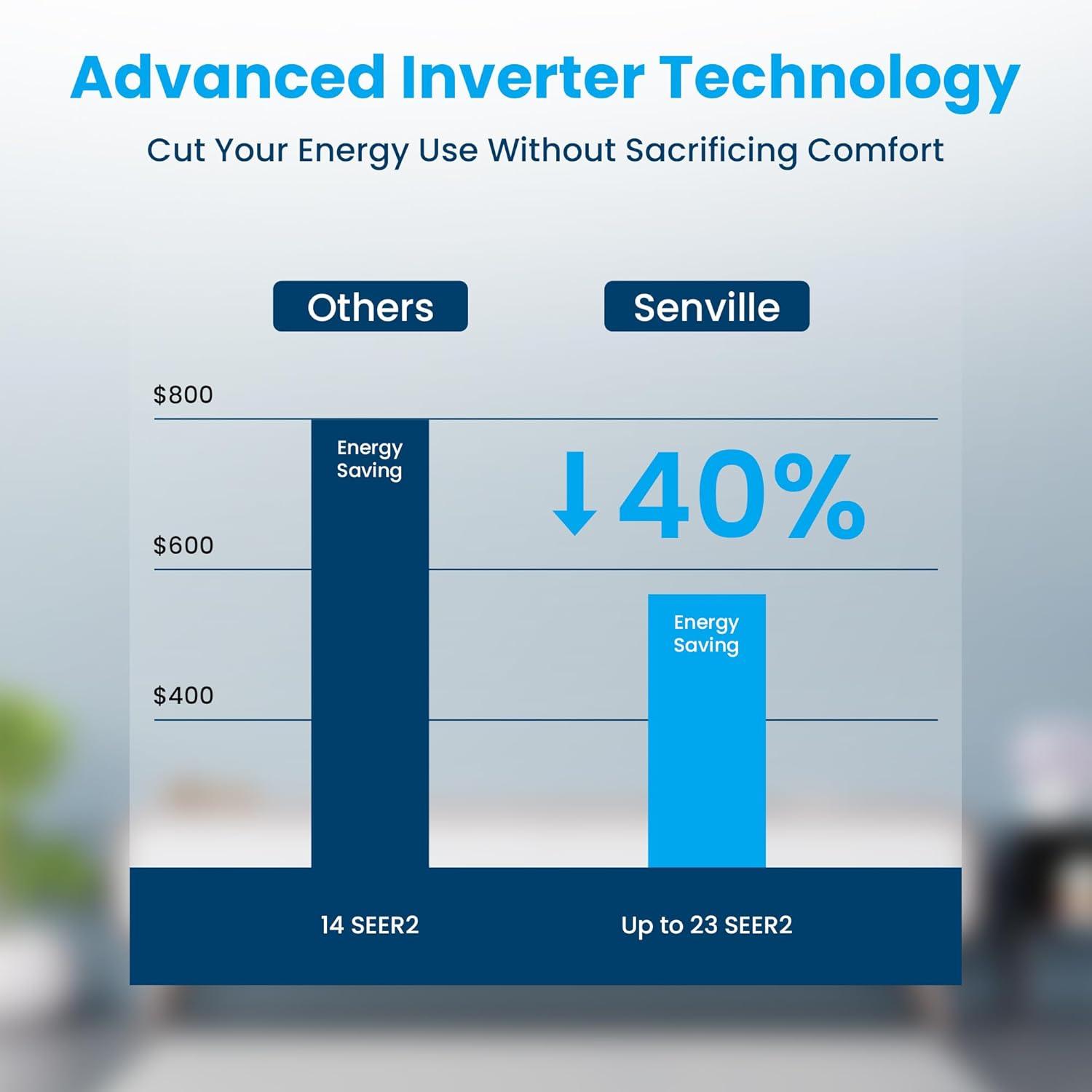
According to senville, this 12,000 BTU concealed-duct system is built around an energy-efficient heat pump design intended to provide air conditioning, heating (rated down to -22°F / -30°C), dehumidification, and fan operation from one platform. For an operating budget, the “real numbers” you can responsibly count on up front are less about promising a specific dollar savings (which depends heavily on electricity rates, insulation, thermostat settings, and what you’re replacing) and more about the cost-control mechanics a mini-split heat pump typically brings: it moves heat rather than generating it, and it can modulate output to better match demand instead of cycling hard on/off like many legacy systems. Senville also claims “energy efficient consumption” and positions this unit for cold-climate use—both of which can matter financially if you’re trying to reduce reliance on higher-cost backup heat in shoulder seasons.
On the customer side, there are a few budget-relevant data points—without inventing a payback calculation. One reviewer explicitly called it “cost-effective compared to my other brand” when comparing similar BTU units, and another Canadian reviewer said they were “saving a tonne of money” using the unit as the primary heat source in a small, well-sealed cottage. At the same time, not every experience supports predictable savings: one U.S.reviewer reported the unit failed in the second year, and another described performance concerns and support delays—events that can quickly erase efficiency gains with repair costs or downtime. The most honest takeaway for an operating budget is that this Senville can support lower run costs in the right application, but you should still plan for variables like cold-weather capacity drop (noted by a Maine homeowner around ~5°F) and the practical limitations of the included thermostat (several comments mention no WiFi/smart control), since controls and reliability affect whether “efficient” translates into consistent monthly savings.
Installation Without Business Disruption in Our Active Operations
Keeping an active business running during HVAC work usually comes down to minimizing demolition, dust, and downtime—and a concealed ducted system can help with that because it centralizes the conditioning equipment out of sight. According to Senville, this is a 12,000 BTU ducted mini split with a built-in drain pump and a wall thermostat, and it includes a 16 ft. installation kit with pre-flared copper lines, communication cable, plus it’s refrigerant pre-charged (25 ft.). In practical terms, those inclusions can reduce the number of extra parts you’re scrambling for mid-project, which is often where “simple installs” turn into multi-day disruptions.Having mentioned that, Senville also notes it requires professional installation, and ducted systems add real planning work—especially around duct routing and return air—so it’s best scheduled during off-hours or staged area-by-area if your operation can’t shut down.Customer feedback supports that the install can be straightforward for experienced hands, but not necessarily plug-and-play for everyone.One reviewer with HVAC experience said the ducted format is “more challenging” because it requires figuring out the ductwork and fabricating plenums, and another reviewer (an electrician) reported the install instructions weren’t complete and they had to rely on YouTube due to missing wiring/thermostat guidance. On the positive side, multiple buyers report successful self-installs and “no issues with installation,” and the unit is frequently described as very quiet—a plus when you’re trying to avoid disrupting meetings, customers, or production. The honest takeaway for active operations: the hardware package and concealed design are conducive to a lower-profile install, but the ductwork and control wiring details are where scheduling, trade coordination, and clear documentation matter most.
Check Current Price & Customer Reviews on Amazon →
Comfort and Airflow Consistency for Our Staff and Customers
Because this is a ducted, concealed mini split, it’s naturally positioned to deliver more even comfort across occupied areas than a single wall-mounted head—assuming the duct design and plenum fabrication are done correctly. According to Senville, this system is a 4‑in‑1 heat pump (AC, heating, dehumidifier, fan with turbo) and is designed for whisper quiet operation; that combination can be a good fit for keeping both staff work areas and customer-facing spaces comfortable without the “hot/cold corner” effect you can get from spot cooling. In general HVAC terms, ducted air distribution can also help reduce drafts by spreading airflow through multiple supply registers rather than blasting from one point.
Having mentioned that, real-world airflow consistency is going to depend on setup details—and the reviews reflect some quirks that could affect perceived comfort. One HVAC-experienced buyer reported the unit “definitely cools,” is “very quiet,” but noted the blower never shuts off even if it reaches temp, which may matter if your team is sensitive to constant air movement. Comfort control also hinges on thermostat feedback: one reviewer complained the thermostat only showed set temperature (not room temperature), while another noted a newer thermostat version that does display interior temperature, and a separate reviewer mentioned flipping a dipswitch to improve temperature-setting accuracy. For customer areas where steady, predictable comfort matters, those thermostat and control details—along with properly sized ductwork—are worth confirming during planning/installation.
Check Current Price & Customer Reviews on Amazon →
Maintenance and Warranty Fit for Our Commercial Use
For commercial use, the day-to-day upkeep on a concealed-duct mini split like this is mostly about staying ahead of airflow and condensate management. As this Senville system is a ducted mini split with a built-in drain pump (per the product description), routine maintenance should include cleaning or replacing the return-air filter(s) on a set schedule, keeping supply/return grilles clear, and periodically verifying the drain pump and condensate line are flowing freely. That last point matters more in commercial settings where run time is higher and any backup can lead to nuisance shutdowns or water issues. One reviewer also noted the condensation line sizing wasn’t standard U.S. PVC, which is worth planning for during install so future service doesn’t turn into a “special adapter” hunt. More generally, ducted systems add another layer of maintenance—checking duct connections, plenums, and static pressure—because duct restrictions can make any HVAC system work harder.
on the warranty side, Senville states a 10-year manufacturer warranty and also advertises free technical & installation support. That’s a strong headline for commercial buyers, but it’s critically important to treat the install requirements seriously: the product description says “Requires Professional Installation” (even though multiple customers report self-installing successfully).Reviews also paint a mixed picture on support—some buyers mentioned responsive support and even simple configuration guidance (like a dipswitch change), while at least one reported a failure in the second year and difficulty getting it repaired, and another complained about not getting a promised callback. For a commercial application where downtime is expensive, the practical takeaway is to document commissioning, keep records of maintenance, and consider lining up a local tech who’s willing to service mini-splits—because warranty terms and “support responsiveness” are only as useful as your ability to get the unit diagnosed and back online quickly.
How It Compares to Other Commercial HVAC Alternatives we Considered

When we compared the Senville 12,000 BTU concealed-duct mini split to other commercial HVAC approaches (like rooftop units, traditional split systems, or non-ductless/ducted heat pump options), its biggest differentiator was how much “complete system” you get in a compact footprint.According to Senville, this is a 4-in-1 system (cooling, heating, dehumidifier, fan) with heating rated down to -22°F (-30°C), and it includes a built-in drain pump—a feature that can be especially helpful in concealed/ducted installs where getting a gravity drain can be awkward. It also ships with a 16 ft installation kit (with pre-flared copper lines and communication cable) and comes pre-charged refrigerant (25 ft), which is more “ready to install” than some alternatives that require piecing together accessories separately (still, Senville notes it requires professional installation).
On the flip side,when stacked against other commercial alternatives that prioritize controls and serviceability,the Senville’s thermostat and documentation came up as potential compromises in customer feedback. Multiple reviewers mentioned limitations like no WiFi/smart control and, on at least one thermostat version, not displaying the current room temperature (although another reviewer said their newer thermostat does display interior temp). A couple of customers also noted install complexity for DIYers—less about the refrigeration side and more about ductwork/plenum fabrication and wiring clarity (one review specifically called out missing/unclear wiring diagram details). Performance feedback is mixed but informative: several owners report it’s very quiet and heats/cools well (including one using the ducted setup for a 1,000 sq ft home), while others reported the system struggled in extreme cold or had reliability issues by the second year—so compared with more established “commercial-first” systems and controls ecosystems, this one can look like a strong value on features, but with more variable experiences around controls, guidance, and long-term reliability.
Check Current Price & Customer Reviews on Amazon →
Customer Reviews Analysis
Customer Experience Summary (from provided reviews)
1. Overall sentiment
Reviews were mixed. Several customers described the system as “excellent,” “awesome,” and effective for heating/cooling, while others said it “didn’t do the job,” struggled in hotter or colder weather, or failed within a couple of years.
2. Common praise (grouped by theme)
Heating & cooling performance (when conditions are moderate to cold)
- Many customers mentioned strong overall comfort and year-round performance. One reviewer said the ducted system “allowed me to properly heat and cool our whole 1k sf house in Maine” and that it was “super in summer and great in winter.”
- One reviewer in very cold conditions reported it kept working in extreme temperatures: during “-35C for about 6-8 hours,” it was “still blowing warmish air.”
- Several reviewers used standout praise like “Great heat pump,” “excellent product,” and “how awesome is this unit.”
Quiet operation
- Multiple reviews praised low noise. One person said it was “so quiet I have to make sure it still works.”
- Another reviewer wrote the outdoor unit was “so quiet you can’t hear it from the end of the driveway (about 30 feet away).”
installation experience (for DIY-capable buyers)
- Some customers reported “No issues with installation,” and another said they were “super pleased” after they “self installed it.”
- A reviewer with multiple units said they were “fairly easy to install (if you have the right tools).”
Customer service / support (in some cases)
- Several reviewers noted positive service experiences, including: “Support has been very responsive.”
- One reviewer shared senville “exchanged it no problem” after they ordered the wrong head.
Thermostat display advancement
- One reviewer liked the “newer thermostat that actually reads and displays interior temp.”
3. Common Concerns (grouped by theme)
Thermostat limitations (no smart/wifi, wiring, accuracy)
- A common theme in reviews was dissatisfaction with thermostat features:
- “Wish it had the wifi capabilities.”
- “The thermostat is not standard wired or wifi/ smart enabled so cant remotely turn on, off…”
- A few customers reported thermostat/setup documentation issues. One reviewer said the install instructions “are not clear,” adding: “There is no wiring diagram, and nothing about hooking up the thermostat… and a bunch of wires.”
- Some customers experienced temperature control swings. One person reported: “The thermostat has a 3 degree +/-… the room swings between 67 and 73 all day and night,” and said support told them that was “normal.”
- One reviewer mentioned needing a settings change: “I had to flip dipswitch one to improve accuracy of temperature setting.”
performance falling off in temperature extremes
- Several reviewers noted reduced heating capacity around very cold conditions:
- One person said around “5f it starts to fall off… starts to struggle to maintain set point as output falls off.”
- Another said it was “working ok in the cold until it got down to 0” and then was “blowing out cold air.”
- Another review stated: “Cooled ok, but didn’t hear [heat] in weather below plus 5° C.”
- Hot-weather cooling limitations were also mentioned. One reviewer said the units “worked well in the summer up to about 80 degrees. Over that they struggled.”
Reliability problems / failures
- Some customers experienced major failures:
- “Second, it failed in our second year Summer.2 techs have been unable to repair it.”
- Another reviewer reported that after a couple months “one started making a very loud noise.”
Support follow-through (in some cases)
- While some found support responsive, others criticized it strongly. One reviewer said support told them to restart the unit and promised a call back, but: “I am still waiting for the call, 52 days later.”
General dissatisfaction (non-specific)
- One short review simply stated: “Didn’t do the job.”
4. Notable Use Cases Customers Described
- Whole-home ducted application: One reviewer used the ducted version to “properly heat and cool our whole 1k sf house in Maine.”
- Cabin / remote property needs: one customer specifically wanted remote control capability and disliked that they “cant remotely turn on, off at my cabin.”
- Small insulated cottage as sole heat source: One reviewer used it as “the only heat source” in a “small and very well insulated/sealed cottage,” and highlighted added “dehumidification.”
- Very cold climate operation: Reviews included operation in “5 degree weather,” “around 5f,” “0,” and down to “-35C,” with experiences ranging from “no problems” to “starts to struggle” to “blowing out cold air.”
Pros & Cons
Strengths
- 12,000 BTU ducted (concealed) design: The product is a 12,000 BTU concealed-duct mini split,which reviewers note can heat/cool larger areas via ductwork (e.g., one reviewer used it to heat/cool a ~1,000 sq ft house with ducts).
- Built-in drain pump: Listed in the product description as a “Built-In Drain Pump,” which can help with condensate removal where gravity drainage isn’t practical.
- All-in-one functionality (AC, heat pump, dehumidifier, fan, turbo): Manufacturer describes it as “4-in-1” with cooling, heating (heat pump), dehumidifier, fan, and turbo function.
- Cold-climate heating claim (rated down to -22°F / -30°C): The description states heating is “Rated Up to -22F/-30C,” and at least one reviewer references this rating in real-world use (noting performance drop as temps get very low).
- whisper-quiet operation (manufacturer claim) supported by multiple reviews: The listing claims “Whisper Quiet Operation,” and multiple reviewers describe the unit as “very quiet”/“so quiet,” including comments about the outdoor unit being hard to hear.
- Installation kit + pre-charged refrigerant to simplify setup: Includes a 16 ft installation kit with pre-flared copper lines and communication cable, and the refrigerant is stated to be “Pre-Charged (25 Ft.).” Reviewers also mention installs going smoothly if you have the right tools/experience.
- Support/coverage mentioned (10-year manufacturer warranty + tech support): The product description lists a “10 Year Manufacturer” warranty and “Free Technical & Installation Support,” and some reviewers report responsive support.
Considerations
- Professional installation required: The product description explicitly states “*Requires Professional Installation,” which can add cost and complexity versus simpler DIY systems.
- more complex installation than ductless mini-splits: A reviewer (HVAC professional) notes ducted installs are “more challenging” due to needing ductwork and fabricating plenums; another reviewer said instructions were unclear and they had to use YouTube, citing missing/insufficient wiring/thermostat hookup guidance.
- Thermostat limitations reported: Multiple reviews mention thermostat drawbacks—one said it “doesn’t display current house temp only set temp,” another described a temperature swing/accuracy issue (reported as ~3°F +/-), and another wished it had WiFi/smart capability for remote control.
- Heating/cooling performance can fall off in more extreme conditions (per reviews): While the unit is rated to -22°F,one reviewer observed it starts to struggle around ~5°F,and another reported poor performance around 0°F; one Canada reviewer said it didn’t heat below about +5°C.
- Some reliability/noise complaints in reviews: At least one reviewer reported the unit “failed in our second year” and couldn’t be repaired by two techs; another reported a unit developing a “very loud noise” after a couple months.
Q&A
Does this system provide both heating and cooling,and how cold can it heat down to?
Yes. This is a ducted mini-split heat pump system that provides air conditioning and heating, plus dehumidifier and fan modes (per the product description). The listing states heating is rated down to -22°F (-30°C).In customer reviews, some users reported it continued heating in very cold weather but noted output can drop as outdoor temperatures get extremely low, which is typical of heat pumps.
How much space can a 12,000 BTU concealed-duct mini split handle?
The unit is 12,000 BTU, but the product page excerpt provided does not give an official square-foot coverage number. In reviews, one customer reported cooling about 600 sq ft, and another described heating/cooling a roughly 1,000 sq ft home using a ducted Senville setup—results that can vary widely based on insulation, ceiling height, duct design, air leakage, number of rooms/returns, and local climate. For accurate sizing, HVAC industry practice is to use a load calculation (e.g., Manual J) and verify with Senville or a licensed contractor.
Does it include an installation kit, and is the refrigerant already in the outdoor unit?
Yes. The product description states it includes a 16 ft installation kit with communication cable and pre-flared copper lines. It also states the refrigerant is pre-charged for up to 25 ft of line length. If your installation requires longer line sets than the factory charge supports, an HVAC professional typically needs to add refrigerant per manufacturer specifications.
Can I install this myself?
The listing notes “Requires Professional Installation.” Even when a customer does parts of the work themselves (mounting equipment,running ducts,etc.), mini-split installations typically require specialized tools and procedures (evacuation with a vacuum pump, verifying refrigerant charge/line length requirements, and electrical work). Several reviewers mentioned self-installing or doing DIY with professional help for evacuation, but outcomes and warranty considerations can vary—confirm requirements with Senville and your local code/permit rules.
What’s the benefit of the built-in drain pump, and are there any drainage/condensate connection considerations?
The product description specifies a built-in drain pump, which can definitely help move condensate water when a gravity drain isn’t practical. one reviewer noted the condensate drain connection did not match “conventional US PVC sizes,” meaning adapters/fittings might potentially be needed depending on how you route the drain. As condensate routing affects reliability (leaks/overflows), check the install manual and plan the drain line and fittings before installation.
Does the wall thermostat show the current room temperature,and does it have Wi‑Fi/smart control?
Based on customer reviews,thermostat behavior can vary by revision: one reviewer reported their thermostat did not display current indoor temperature (only set temperature),while another reported receiving a “newer thermostat that actually reads and displays interior temp.” Multiple reviewers also noted they wished it had Wi‑Fi/smart capability; Wi‑Fi is not claimed in the provided product description excerpt. For the exact thermostat version and features included with the current listing, verify on the Amazon product page and/or with Senville support.
Is this system considered quiet?
The product description states “Whisper Quiet Operation.” Reviews frequently describe the system as very quiet in operation (both indoor comfort and outdoor compressor noise), though perceived sound depends on installation details like duct sizing, plenum design, mounting isolation, and airflow settings.
transform Your World
SUMMARY: The Senville 12,000 BTU concealed-duct mini split is a single-zone heat pump system designed for streamlined, low-profile installs, with a built-in drain pump, wall thermostat, and a 16 ft installation kit (pre-flared lines). reviews commonly highlight quiet operation and solid heating/cooling for appropriately sized spaces, while also noting that ducted installs require more planning than typical wall-mounted heads.
BEST FOR: Bedrooms, additions, garages, or small homes where you want central-style airflow through ducts and don’t mind hiring an HVAC pro. It can also fit colder-climate use cases since it’s rated to heat down to -22°F (-30°C),though real-world output can drop in very low temperatures.
CONSIDER ALTERNATIVES IF: You need built-in Wi‑Fi/smart thermostat features, want clearer DIY documentation, or require dependable performance at extreme temps without supplemental heat. A few reviews mention thermostat quirks, support frustrations, or long-term reliability issues.
FINAL THOUGHT: A compelling ducted option on paper, but best for buyers comfortable with a more complex install and realistic cold-weather expectations.
Ready to learn more? View Full Specifications & Latest Reviews on Amazon →