
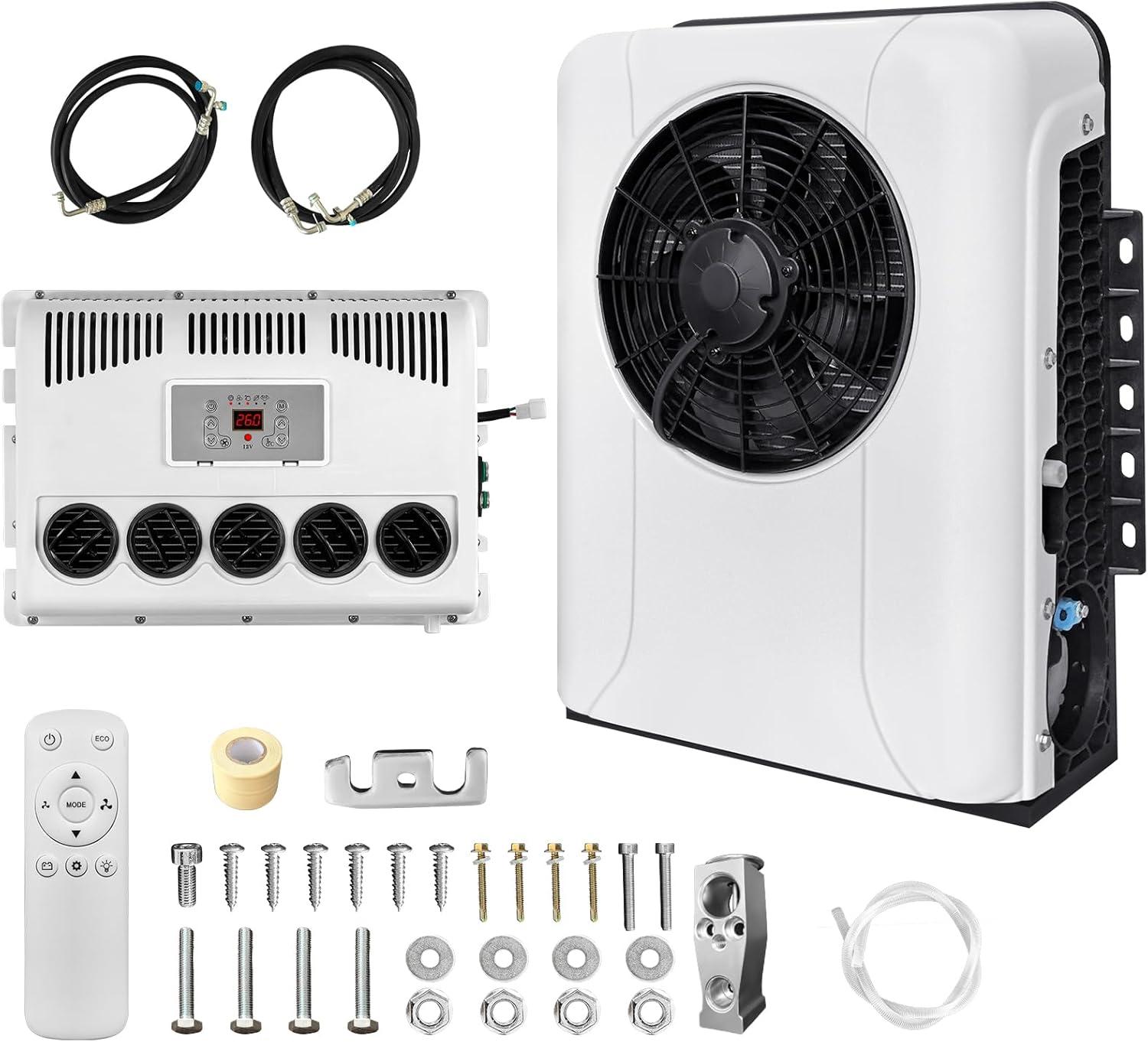
Ever tried to sleep in a truck cab or camper after you’ve parked for the night—only to find the heat lingers long after the engine is off? If you’re looking for a 12V cooling setup designed for real roadside downtime, this DC 12V split-type automotive parking air conditioner is built for rvs, vans, truck cabs, motorhomes, campers, and more.
This is a mini split-style system with separate indoor and outdoor units to help you use vehicle space more efficiently. The indoor unit measures 16.9 × 5.5 × 12.2 inches, and the outdoor unit is 21.7 × 7.9 × 26.1 inches. According to the manufacturer, it uses intelligent frequency conversion, a scroll compressor, a thick aluminum condenser, seven fans for heat dissipation, and 360-degree wide-angle air supply, with low-voltage protection and ABS construction for durability.
In this review, we’ll walk through what’s included (lines, cables, drainage, remote), installation considerations (vacuum and R134A requirements), usability, and real-world expectations. We’ve researched and followed mini-split and inverter-style AC setups in small spaces,so we know what details matter before committing.
Commercial Performance Overview for fleet Cooling Efficiency and Operational Reliability
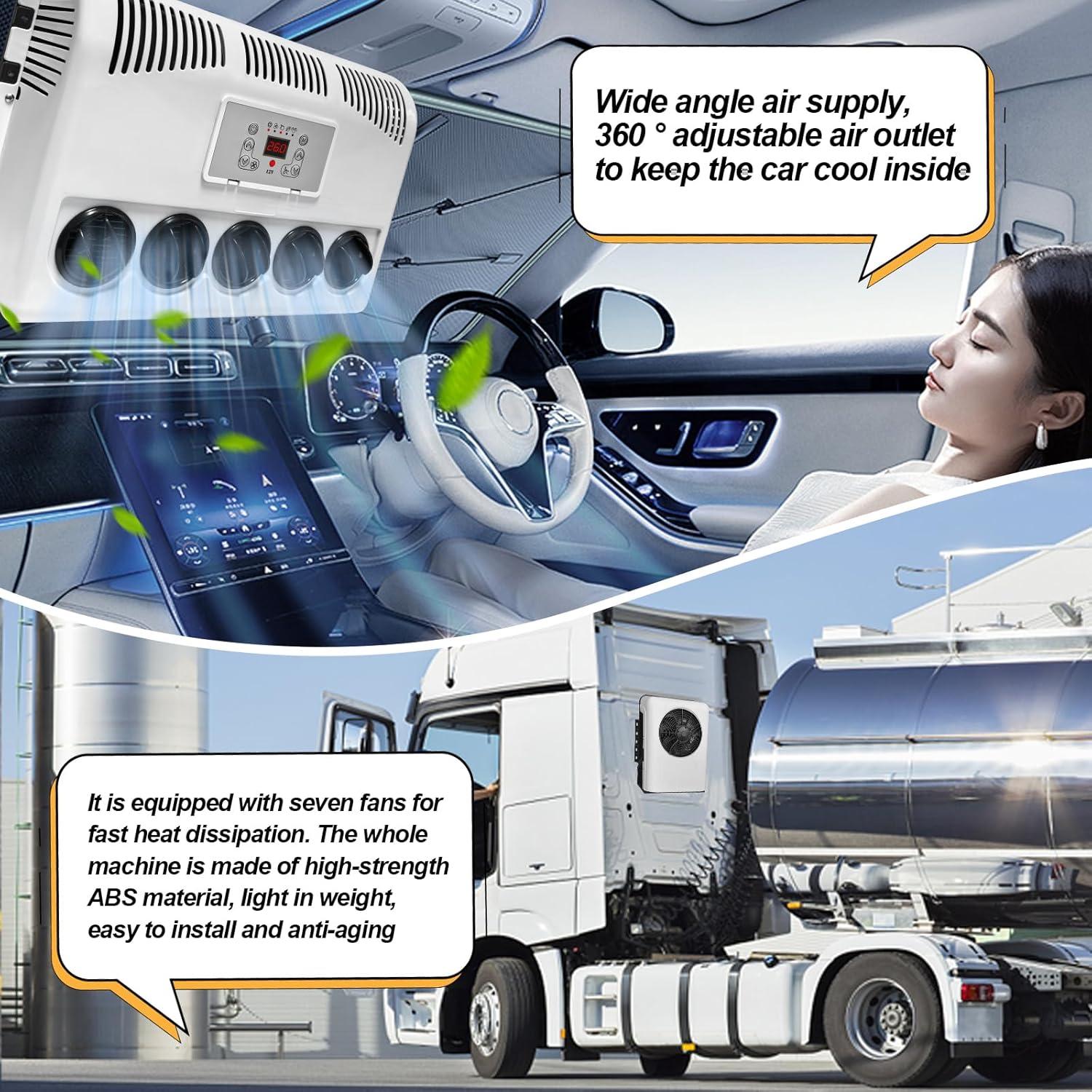
For fleets and drivers who need dependable cooling during loading breaks or overnight parking, this DC 12V split-type setup is positioned as a space-efficient option because the indoor and outdoor sections are separate. According to the manufacturer, it uses a scroll compressor, a thick aluminum condenser, and intelligent frequency conversion to deliver “rapid cooling” while keeping operation energy-saving and low-noise.They also highlight a 360-degree wide-angle air supply and an outdoor unit designed for fast heat dissipation with seven fans—all aimed at maintaining steady cabin comfort when conditions or heat loads change throughout a workday.
On the real-world reliability side, one customer reports successful installation in a fifth-wheel bedroom area and says they’ve been “very pleased” with the result after about a week of use—specifically noting overnight comfort when running from a 400Ah battery setup at a low setting. That same review also hints at a key operational consideration for commercial use: where you mount the outdoor/blower unit and how you manage airflow around it (they ran it with the hatch open). Beyond comfort, the product description emphasizes protective measures intended to support operational reliability, including low-voltage protection and a design meant to handle electrical surges and vehicle vibration; however, long-term durability outcomes aren’t established by the limited review data provided.
Check current Price & customer Reviews on Amazon →
Energy Cost Savings Real Numbers for power Draw and Total Operating Costs

When it comes to energy cost savings, the most honest “real numbers” we can point to here are about where the power comes from and how the unit is designed to manage draw—not a promised wattage chart (because the listing doesn’t provide verified amps/watts, BTU, or SEER).According to the manufacturer, this is a DC 12V split air conditioner that uses intelligent frequency conversion (inverter-style modulation) along with a scroll compressor and thick aluminum condenser to deliver “efficient and energy-saving” cooling. In practical terms (general HVAC knowledge), frequency conversion is meant to avoid constant on/off cycling by ramping compressor speed up and down to match demand, which typically reduces peak draw and can lower total energy use in steady conditions—but the exact operating cost depends on your battery system, ambient temperature, insulation, and setpoint.
For a more grounded picture of operating impact, one reviewer provides a helpful real-world use case: they’re running the unit from a 400 amp-hour battery setup, and report that “at low setting it gets me through the night” while keeping the bedroom area comfortable. That doesn’t translate into an exact watt figure—but it does indicate that, at least for some setups, overnight runtime is achievable on battery power at lower output. If you want to estimate your own total operating costs without guessing, you’ll need the unit’s actual running amps (or watts) at different fan/compressor speeds—data that isn’t listed here—then convert to energy use against your battery voltage/capacity (and charging source cost).
Check Current Price & Customer Reviews on Amazon →
Installation Without Business Disruption for Active fleets and On Road Operations
For fleets that can’t afford downtime, this unit’s split design is a practical starting point: the indoor head (16.9 × 5.5 × 12.2 in) and outdoor unit (21.7 × 7.9 × 26.1 in) can be placed separately to make better use of available vehicle space, according to the manufacturer. The package list is also oriented toward a self-contained install, including high/low pressure pipes (123.6 in each), a drainage pipe (59 in), a battery cable (9.5 ft), a signal line (9.5 ft), and “other accessories,” which can help reduce mid-job parts runs that stall work trucks and service rigs. One reviewer reported a creative, low-disruption approach in an RV setting—mounting the indoor head where a factory TV was removed and placing the outdoor blower unit in a battery compartment—suggesting the layout versatility can translate well when space is at a premium.
That said, “easy to install” still comes with real operational planning. The manufacturer explicitly notes that the system ships without refrigerant and requires vacuum treatment for 15–20 minutes before charging with 590 g of R134A; they also warn not to run the compressor without refrigerant, and mention onboard fault indication (e.g., voltage or charge issues) via a flashing panel light. For on-road operations, that means the least disruptive path is usually staging vehicles so installation and evacuation/charging happen in one controlled window—especially since the unit is designed for DC 12V battery power and includes low voltage protection (manufacturer claim), which matters when trucks need to remain start-ready after an overnight rest. If your fleet doesn’t already handle mobile A/C evacuation and charging, budgeting for a qualified tech for the refrigerant steps can be the difference between a smooth rollout and vehicles sitting idle waiting for rework.
Check Current price & Customer Reviews on Amazon →
Comfort and Productivity Impact for Drivers Customers and Onsite Teams
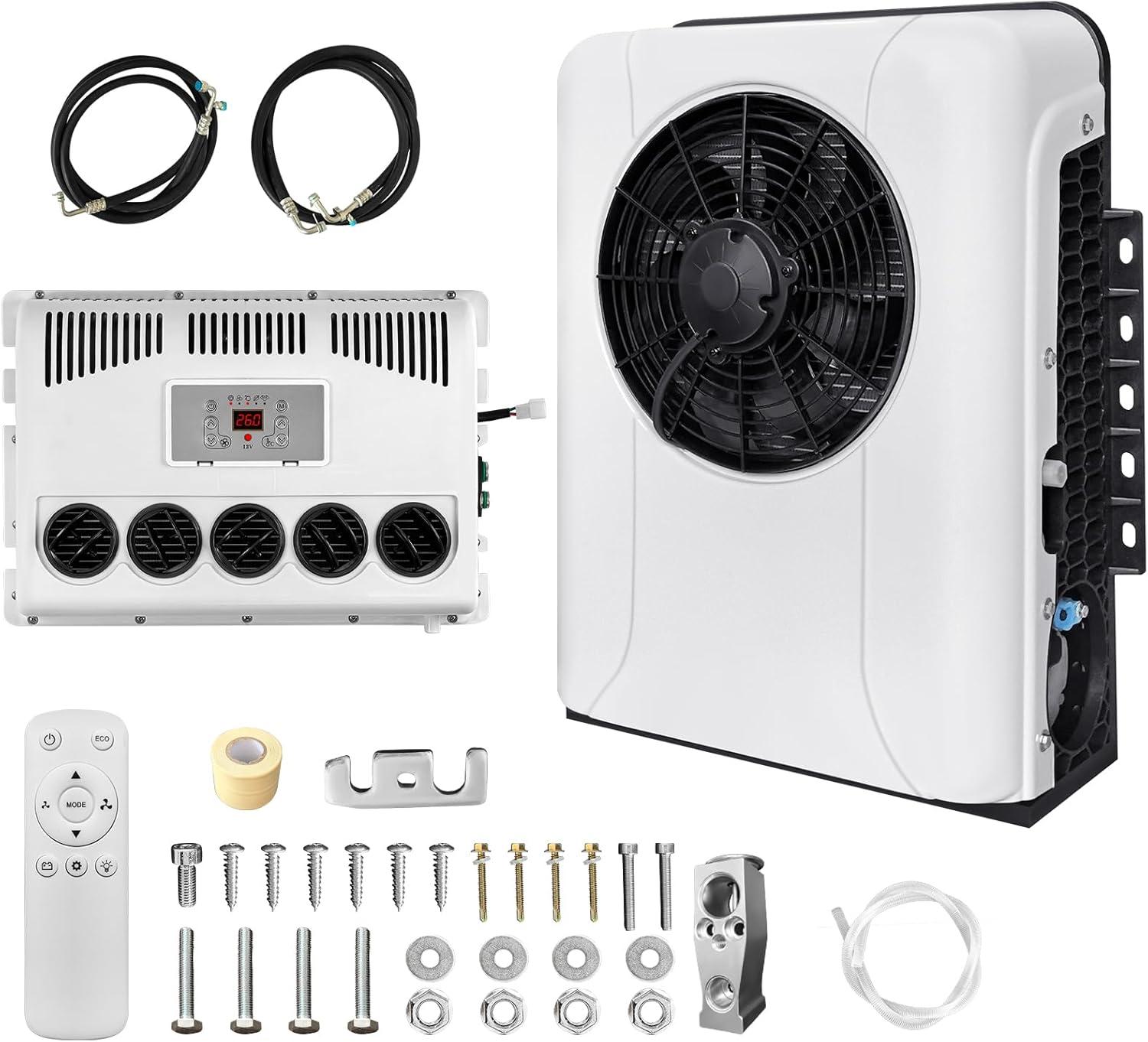
This DC 12V split-style mini split is positioned as a comfort upgrade for peopel who spend long hours in a cab, RV, or work vehicle—especially when parked. According to the manufacturer, the unit is designed so the engine can remain off while the system continues running on battery power, and it combines intelligent frequency conversion with 360-degree wide-angle air supply for steadier cooling and fewer hot spots. Convenience also plays into comfort: the included remote control and onboard digital display/control panel make it easier for drivers to dial in temperature and fan speed without getting up or fumbling with elaborate controls. for overnight stops or waiting on-site, that “set it and rest” usability can translate into better sleep and less fatigue the next day.
For productivity—whether that’s a driver staying alert, a customer staying comfortable in a camper, or an onsite crew taking breaks in a service vehicle—cooling performance and noise both matter. The product description emphasizes low-noise ventilation and fast heat dissipation using multiple fans, which are intended to keep the system operating smoothly during hot weather. In the available customer feedback, one owner reports installing it in the bedroom area of a fifth wheel and being able to keep the space comfortable through the night on a 400Ah battery setup at a low setting—an example of how this kind of 12V parking A/C can support real rest during downtime.Keep in mind that installation quality and correct refrigerant handling are critical for consistent comfort: the manufacturer notes the system ships withoutR134A and requires vacuuming before charging, so a proper install can be the difference between “comfortable all night” and underwhelming performance.
Check Current price & Customer Reviews on Amazon →
Maintenance and Warranty Readiness for Commercial Use and Downtime Control
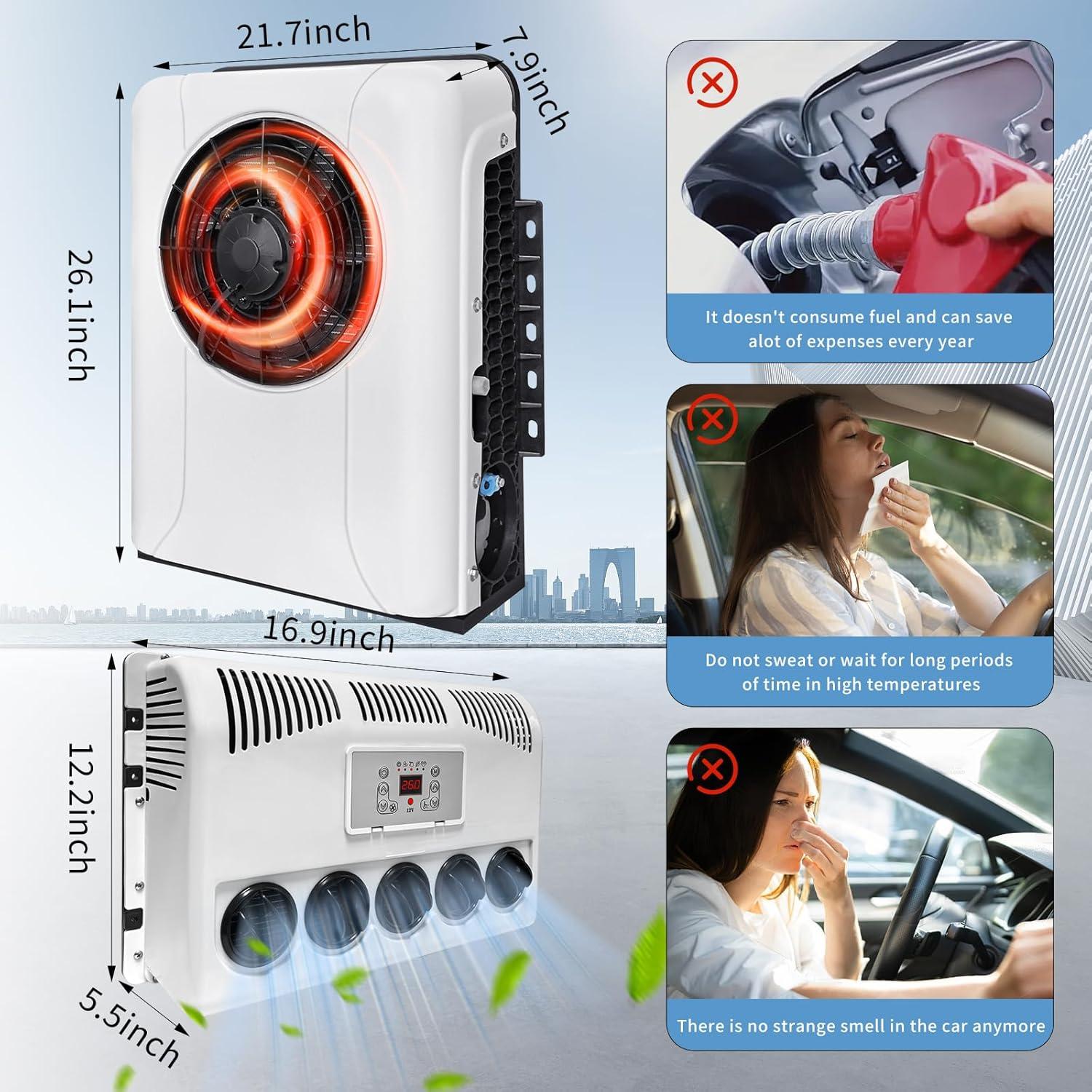
For commercial-style use where downtime matters (overnight parking, sleeper cabs, service vehicles, or RV rental fleets), maintenance readiness starts with what the manufacturer includes and how serviceable the setup is. This is a split system with independent indoor and outdoor units, and the box list is fairly complete for getting installed without hunting for basic plumbing/electrical pieces:
- Indoor unit (16.9 × 5.5 × 12.2 in) + Outdoor unit (21.7 × 7.9 × 26.1 in)
- High- and low-pressure pipes (123.6 in each) and drain pipe (59 in)
- Battery cable (9.5 ft) + signal line (9.5 ft)
- Remote control and other accessories (per listing)
According to the product description, the unit is designed to be “easy maintenance” and uses a modular split layout that can make access simpler than a one-piece rooftop/under-bunk assembly. The manufacturer also claims a low voltage protection function plus multiple protective measures against surges/vibration—features that can help reduce nuisance shutdowns in real-world vehicle power conditions, which is a key part of downtime control.
Warranty readiness (and avoiding self-inflicted failures) depends heavily on doing the refrigeration steps correctly, because the listing is explicit about pre-charge and commissioning.The manufacturer notes you should not run the compressor without refrigerant and specifies it ships without R134A, stating 590 g of R134A must be added and a 15–20 minute vacuum should be performed before charging; it also calls out labeled high (“H”) and low (“L”) pressure ports.For fleet operators or anyone who can’t afford repeated callbacks, that strongly suggests treating installation like an HVAC job—use proper vacuum equipment, verify charge, and keep documentation/photos of the process in case warranty support asks for proof. The unit also mentions a panel flashing indicator light and a fault diagram for issues like voltage problems or incorrect refrigerant amount, which can speed up troubleshooting and get you back online faster. One reviewer who installed it in a fifth wheel reports being pleased after about a week of use and successfully running it overnight on a 400Ah battery setup at low settings, which is promising for parked operation—but long-term reliability and warranty terms aren’t provided in the source material, so those details should be confirmed on the listing before purchase.
Check Current Price & Customer Reviews on Amazon →
Comparison to Commercial Alternatives for Value Efficiency and Long Term ROI
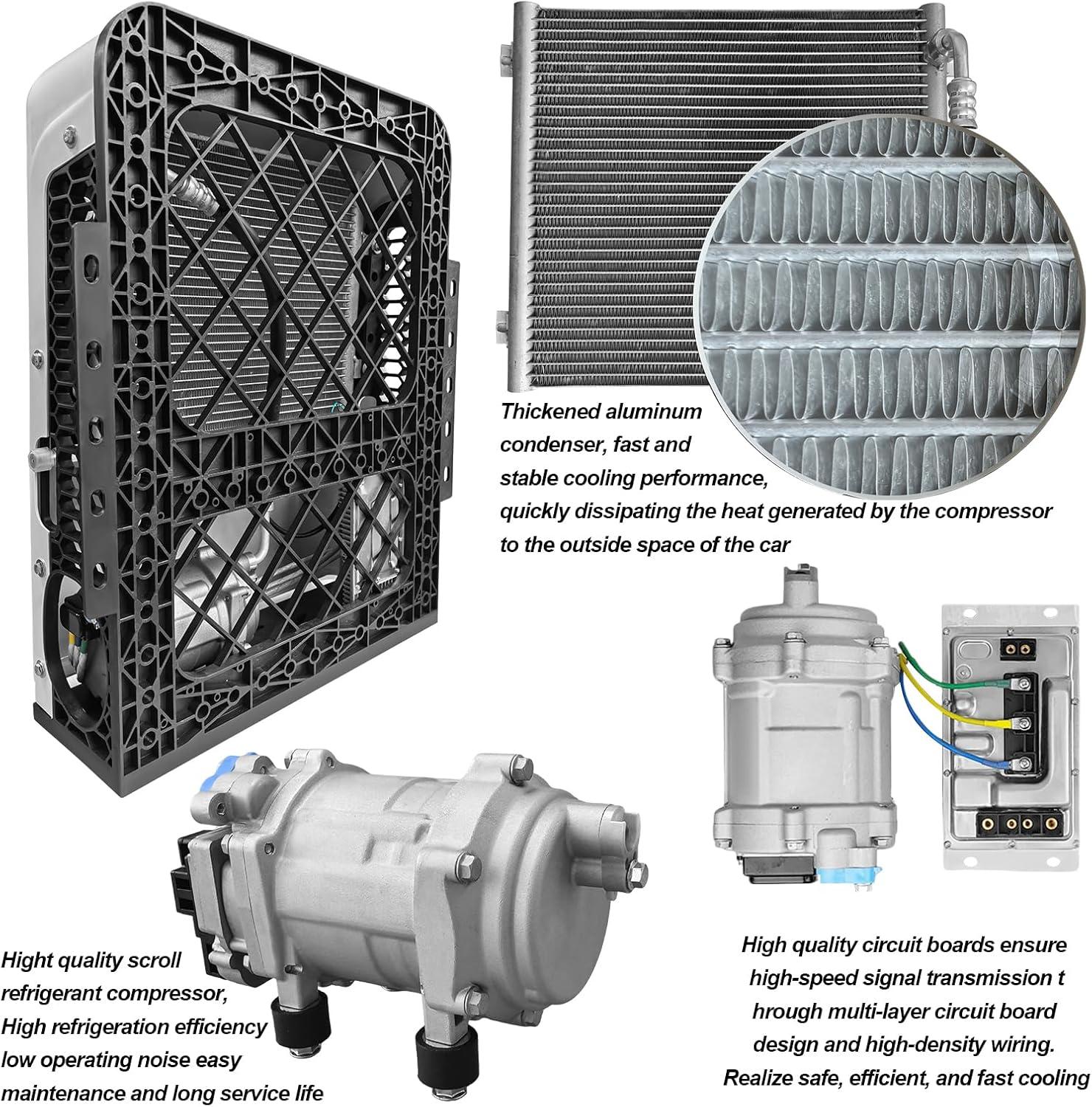
When you compare this DC 12V split “parking A/C” mini-split to manny commercial truck/RV alternatives, the biggest value-efficiency advantage is that it’s designed to cool while the vehicle is parked and the engine is off, using a battery power supply and intelligent frequency conversion (inverter-style) control (per the manufacturer). That makes it a different use-case than relying on the vehicle’s engine-driven A/C, running a generator, or plugging into shore power every time you want overnight comfort. The split design (separate indoor and outdoor units) is also positioned as a space-efficient approach (again, per the manufacturer), and the component list is relatively complete for a typical install—indoor/outdoor units, remote control, refrigerant lines, drainage pipe, wiring, and accessories—which can improve the overall value proposition versus options that require piecing together major parts separately.
For long-term ROI, the safest way to look at it is “total ownership practicality” rather than promising a payback timeline. The manufacturer claims energy-saving, low-noise operation, a scroll compressor, a thick aluminum condenser, seven fans for heat dissipation, high-strength ABS construction with UV/anti-aging resistance, and low-voltage protection—all features that (in general HVAC terms) are intended to support efficiency, durability, and fewer operational headaches over time. In early real-world feedback, one reviewer reported successfully running it from a 400Ah battery setup and getting through the night on a low setting while keeping a fifth-wheel bedroom comfortable, which suggests it can be a workable alternative to more expensive or more power-hungry solutions in at least some setups. Having mentioned that, your long-term value will still depend heavily on installation quality and correct refrigeration commissioning (the listing notes vacuum treatment is required and that it ships without R134A, requiring a 590g charge), so budgeting for proper tools or professional help can be a smart part of an ROI-focused comparison.
Check Current Price & Customer Reviews on Amazon →
Customer Reviews Analysis
Customer Experience Summary
1. Overall Sentiment
Overall sentiment in the provided review was positive. The reviewer said they’ve been “very pleased” after about a week of use and described the unit as keeping the space “comfortable.”
2. Common Praise
Installation / Fitment
- The reviewer described a successful, creative install using existing hardware: they “took out the factory installed TV… and used that mount to install the head.”
- They also noted how they positioned the outdoor unit: “The outside blower unit I’ve got in the battery compartment.”
Performance (Cooling / Comfort)
- The reviewer reported it maintained comfort overnight: “At low setting it gets me through the night while keeping the bedroom area comfortable.”
Power Use / Battery Operation
- A specific theme was running it off a battery system: “I’m running out of 400 amp hour battery setup,” and on low it lasted overnight.
3.Common Concerns
only one review was provided, and it did not include explicit complaints about cooling effectiveness, noise, reliability, or defects.
- The closest thing to a limitation mentioned was operational setup: they said, “I keep the hatch open outside when I’m running it” because the outdoor unit was placed in the battery compartment (not framed as a negative, but it is a requirement in their setup).
4.Notable Use Cases
- Fifth wheel RV bedroom cooling: Installed “in the bedroom space of my fifth wheel.”
- Replacing a factory TV location: Used the removed TV mount for indoor head placement.
- Outdoor unit in battery compartment with hatch open: “outside blower unit… in the battery compartment… hatch open.”
- Overnight cooling on batteries: Ran from a “400 amp hour battery setup,” lasting “through the night” on low while maintaining comfort.
Pros & Cons
Strengths
- True split design for flexible mounting: The description states it has independent indoor and outdoor units to make better use of vehicle space.
- 12V DC “parking A/C” functionality: marketed as a parking air conditioner that can run when the engine is off (battery power supply) for resting/waiting in the vehicle.
- Variable-frequency (inverter-style) operation + low-noise claim: Manufacturer claims “intelligent frequency conversion” for efficient cooling and low-noise operation, including when the engine is turned off.
- Includes a remote control and control-panel operation: Package list includes a remote control,and the description notes temperature and fan speed can be adjusted via the panel or remote,with a digital display.
- Good accessory bundle for install plumbing/wiring runs: Package includes high/low pressure pipes (each 123.6 inches), drainage pipe (59 inches), battery cable (9.5 ft), and signal line (9.5 ft), plus “other accessories.”
- Durability/safety features are explicitly claimed: High-strength ABS construction with UV/anti-aging claims, a seven-blade fan for heat dissipation, and built-in low-voltage protection are all stated in the product description.
Considerations
- Refrigerant is not pre-filled (additional work + supplies required): The listing says R134A is “not add before shipping” and specifies adding 590 g after vacuum treatment (15–20 minutes) before operation.
- Installation is more technical than “plug-and-play”: The manufacturer requires vacuuming and proper charging, and notes a fault indicator light may flash for issues like insufficient voltage or incorrect refrigerant amount—suggesting installation/setup errors can prevent operation.
- Space planning is needed for both indoor and outdoor units: the package lists fixed unit dimensions (Indoor: 16.9 × 5.5 × 12.2 in; outdoor: 21.7 × 7.9 × 26.1 in), which may not fit every vehicle location without modification.
- Outdoor unit placement can affect practicality: A customer review describes mounting the outdoor unit in a fifth-wheel battery compartment and keeping the hatch open while running it, indicating some installs may require compromises for airflow/venting.
Q&A
Is this a true split system (separate indoor and outdoor units), and what are the dimensions?
Yes. The product description states it is indeed a split type design with independent indoor and outdoor units. Package details list the indoor unit size as 16.9 × 5.5 × 12.2 inches and the outdoor unit size as 21.7 × 7.9 × 26.1 inches. Always measure your available mounting locations (including clearance for airflow) before purchasing.
What comes in the package (lines,drain,wiring,remote)?
Per the product description,the package includes: indoor unit (1),outdoor unit (1),remote control (1),wooden board (1),high-pressure pipe (1) and low-pressure pipe (1) (each 123.6 inches long),drainage pipe (1) (59 inches),battery cable (1) (9.5 ft), signal line (1) (9.5 ft),and other accessories as shown in the listing pictures.Verify the exact contents against the Amazon listing images and the seller’s packing list when it arrives.
does it come pre-charged with refrigerant? What refrigerant and how much is required?
No.The listing notes that refrigerant is not added before shipping and warns not to operate the compressor without refrigerant. It specifies R134A and states it should be charged with 590 grams. It also states a vacuum procedure must be performed for 15–20 minutes before adding R134A. If you are not trained/equipped for evacuating and charging refrigeration systems, check with a qualified automotive/HVAC technician and local regulations.
What power system does it use, and can it run with the vehicle engine off?
The product is described as a DC 12V split air conditioner and is marketed as a “parking air conditioner,” intended to operate when the vehicle is parked (engine off) using battery power. Actual runtime depends on your battery capacity, wiring, and operating setting; one reviewer reported running it overnight on a 400Ah battery setup at a low setting. For your vehicle, confirm battery capacity, charging setup, and safe cable sizing with an installer.
How is it controlled, and what airflow features does the indoor unit have?
It includes a portable electronic remote control and also has a control panel with a digital display.The listing also mentions “360 degree wide-angle air supply” and “multiple air vents” on the internal unit, with adjustable temperature and wind speed via the panel or remote.
What protections or fault indicators does it have?
The description states it has a low voltage protection function.It also says that if a step is done incorrectly during installation, an indicator light on the panel will flash, and you can use the unit’s “panel fault diagram” (referenced in the listing) to confirm issues such as insufficient voltage or insufficient/excessive R134A. For the official fault-code meanings, refer to the Amazon listing documentation or contact the manufacturer/seller.
What vehicles is it compatible with,and where can the outdoor unit be mounted?
The listing claims wide compatibility for “most” RV vans,trucks,excavators,cranes,agricultural vehicles,and construction machinery. because installations vary, confirm you have adequate space and ventilation for the outdoor unit and that condensate drain routing is possible. One reviewer reported mounting the outdoor unit in a fifth-wheel battery compartment and keeping the hatch open during operation for airflow. For your specific vehicle and mounting plan, verify fitment and ventilation requirements with the manufacturer/seller via the Amazon product page and Q&A.
Elevate Your Lifestyle
SUMMARY: This DC 12V split-type parking air conditioner is built for vehicle installs where you want separate indoor (16.9 × 5.5 × 12.2 in) and outdoor (21.7 × 7.9 × 26.1 in) units, plus remote/panel control, 360° air supply, and “intelligent frequency conversion” for quieter, steadier operation.It’s aimed at truck cabs, vans, RVs, campers, and other equipment that needs cooling while parked.
BEST FOR: Overnight cooling in a small RV zone (like a bedroom) or a truck/van living area—especially if you already have a sizable 12V battery bank.Review feedback commonly highlights solid cooling and acceptable noise, with creative mounting options.
CONSIDER ALTERNATIVES IF: You want a simple plug-and-play setup. Installation requires vacuuming the lines and charging 590g of R134A (not included), and space for the outdoor unit matters.
FINAL THOUGHT: Promising concept for off-grid, vehicle-based cooling—just plan the install carefully and verify electrical/space requirements.
Ready to learn more? View Full Specifications & Latest Reviews on Amazon →
Disclosure: This post contains affiliate links. If you purchase through these links, we may earn a commission at no additional cost to you. We only recommend products based on verified specifications and customer reviews.